

EBOOK
Before Sit for the CFA Exam eBook
Get advice from CFA Charterholders for a successful exam day.CFA Career Insights
April 14, 2026
Not finding what you’re looking for?
After months of studying, reviewing, hard work, and probably some nervousness, you’ve passed Level I of the CFA® exam. Now that you’ve conquered this first milestone, you might be wondering if it can help you in your career. If you’re in the final year of earning your bachelor’s degree, perhaps you’re wondering if passing Level I can open doors for you in your job search. Or, if you’re already working in finance, maybe you think it could help you get a better role. This article has the answers for you.
Passing the CFA Level I exam can help you get an entry-level finance job, such as intern, accountant, or investment analyst.
It won't guarantee a job or a raise, but it shows your commitment and knowledge of basic financial concepts.
To advance in your finance career, you'll need to continue pursuing the CFA charter by passing Levels II and III.
In a recent Kaplan Schweser CFA Survey, the vast majority (87%) of respondents are practicing financial professionals. The majority of respondents worked as financial professionals for more than five years.
Respondents who had most recently passed the CFA Level I exam were actually more tenured on average than those who most recently passed the CFA Level II or III exams, or recent charterholders. This may be due to some candidates choosing to end their pursuit of the charter after passing their Level I exam.
The largest fields represented from all respondents were:
Investment Management: 35%
Banking: 14%
Financial Planning: 8%
Accounting/Tax: 6%
Private Equity: 4%
Respondents also had a wide range of job titles, with the most prevalent being:
Portfolio Manager: 9%
Research Analyst: 8%
Consultant: 8%
Wealth Manager: 7%
Accountant: 6.6%
Risk Analyst/Manager: 6.6%
Equity Analyst: 6.6%
The salary you earn after passing Level I of the CFA exam is dependent on your current job responsibilities and employer. You do not automatically qualify for a salary increase by passing the CFA level I exam unless that was agreed upon between you and your employer.
However, in a recent Kaplan Schweser CFA Survey, one-third of our respondents claimed to have received a salary increase after passing their latest CFA exam or becoming a charterholder.

On average, our respondents who were working in a financial professional role both the year before and year after passing their most recent CFA exam or becoming a charterholder stated they experienced an increase in their earnings of 15%.# Earnings increase varied somewhat by the most recent exam passed or becoming a charterholder.

Before you start envisioning your new career as an asset manager or risk manager because of your Level I credentials, there are a few things you should keep in mind. Yes, those job prospects look good, especially if you don’t have one yet. But the problem with them is that there is no information in the statistics that shows whether passing Level 1 of the CFA exam made any impact during the hiring process. And if you search forums like 300Hours, Quora, or Reddit to learn whether passing Level I helped anyone get a job, you’ll get a mixed bag of responses.
Some will declare that passing Level I won’t help you at all. Others say passing Level I can help you get a good finance job with a competitive salary in some parts of the world, but not everywhere. And, there are still others who say it absolutely helped them in their careers in one of two ways:
Passing Level I was a deciding factor when they were competing with someone who was equally qualified for the position but hadn’t passed.
They had already held careers in finance when they passed Level I.
Why are there so many different opinions? The answer to that question depends on how the forum posters approached job hunting after they passed. Quite a few job candidates think that passing Level I should be enough to get them their dream job. They’re looking for a shortcut on a career journey that is competitive and requires hard work. They are the ones who will tell you that passing the exam didn’t help. If you take the same approach, you are likely to be disappointed.
Those who say they were able to get a good job at a finance firm after passing Level I had a different view of how to leverage this accomplishment.
According to CFAI, the most common job title for a CFA charterholder is Portfolio Manager. Below is a table representing the 5 most common job titles for CFA charterholders and which function of investment management they work in.
Function | Title | Number of Charterholders |
|---|---|---|
Buy Side | Portfolio Manager (including hedge fund manager) | 33,000 |
Sell Side | Equity Research Analyst | 18,000 |
Buy Side | Private Wealth Management | 9,300 |
Advisory | Corporate Finance/M&A | 8,400 |
Corporate | Private Equity General Partner | 8,000 |
Those who have successfully found employment in a finance capacity after passing Level I applied the same determination to their job search as they did to studying and passing. They parlayed the techniques they used to create a CFA study plan, stick to that plan, learn the material, and stay calm on exam day to finding a job.
They networked, used personal contacts, joined a CFA society, spent hours on social media, and attended career fairs. They honed their presentation skills, worked on portraying a specific image or showcasing a specialized skill, and didn’t let themselves get discouraged. With concerted effort, this could be you. You can also use the fact that you passed as a confidence builder when going into an interview. After all, passing Level I means you have a good grasp of basic financial concepts, and that is something for which you can be proud.
According to a recent Kaplan Schweser CFA Survey, pursuing the CFA charter had a significant impact on candidates’ career trajectory, remuneration, satisfaction levels, and sentiments regarding their position and employer.
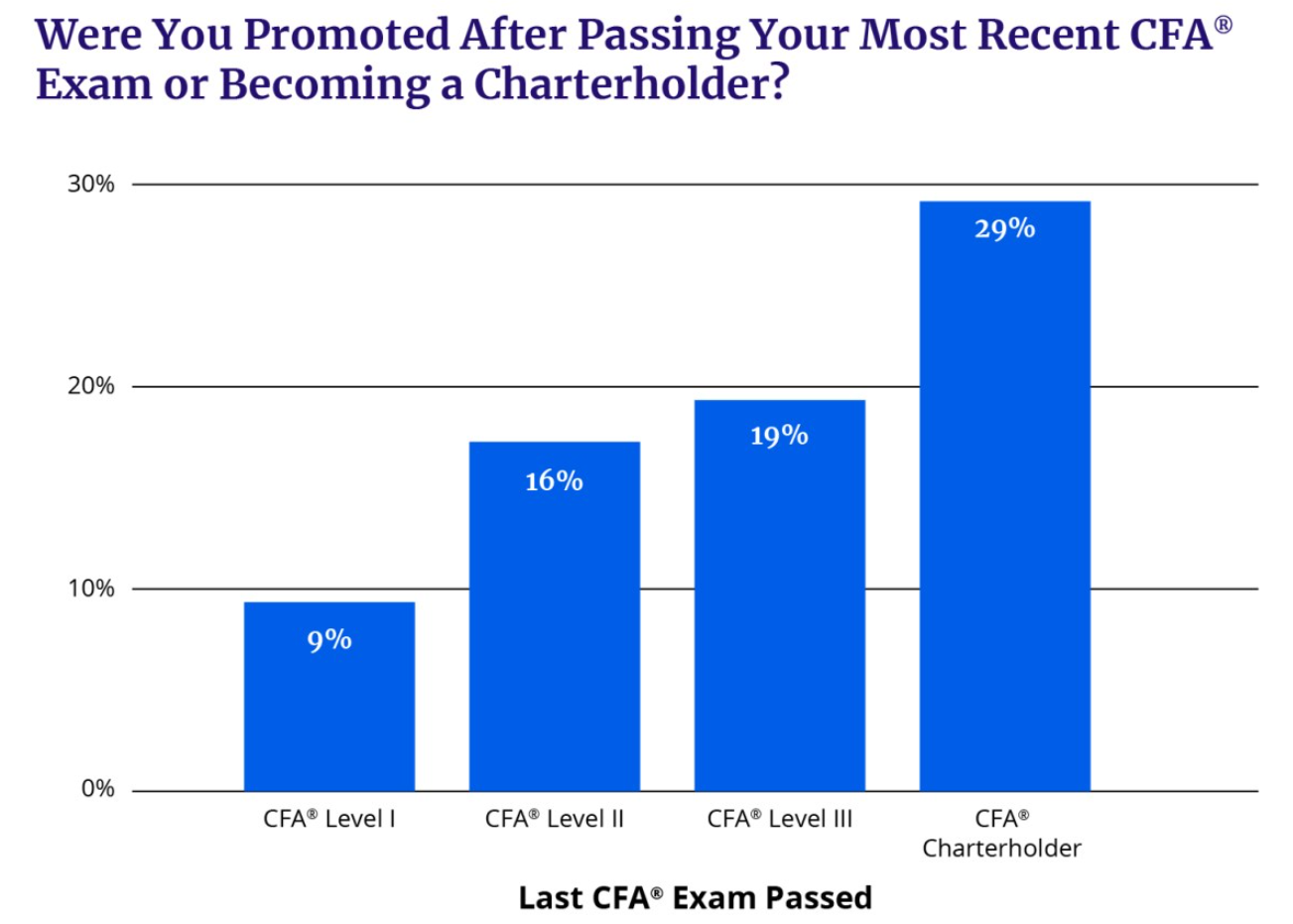
20% of our respondents stated they received a promotion after passing their latest CFA exam or becoming a charterholder.§ Those who became charterholders were most likely to receive a promotion.
No, ChatGPT and similar language models are nowhere close to be able to perform the tasks that CFA charterholders do on a daily basis. Remember that to become a CFA charterholder you will need on-the-job experience which cannot be replicated by any AI model.
If you’re excited about demonstrating your commitment to earning the CFA charter to a potential or current employer, why not get started today? Find answers to frequently asked questions about the CFA exam, or explore our CFA Level II study package options.
Before Sit for the CFA Exam eBook
Get advice from CFA Charterholders for a successful exam day.
CFA Program Fundamentals eBook
Unlock in-depth overviews of CFA Program curriculum topics.




#Earnings increases are dependent on numerous factors other than, or in addition to, passing a CFA® exam or becoming a CFA® charterholder, including specific employment conditions and individual experience. Kaplan Schweser does not guarantee any earnings increase resulting directly from such designation. These are the findings of a quantitative survey conducted by Kaplan between May 2 and May 27, 2024. For this survey, a sample of 728 CFA® Level I, II, and IIII candidates and charterholders was interviewed online. The earnings increase was based on 353 CFA Candidates who most recently passed the CFA Level I, II, or III exam and were employed in a financial professional role both the year before and the year after passing the exam.
§Promotions are dependent on numerous factors other than, or in addition to, passing a CFA® exam or becoming a CFA® charterholder, including specific employment conditions and individual experience. Kaplan Schweser does not guarantee any promotions resulting directly from such designation. These are the findings of a quantitative survey conducted by Kaplan between May 2 and May 27, 2024. For this survey, a sample of 728 CFA® Level I, II, and III candidates and charterholders was interviewed online, of which 709 were employed at the time of the survey.